
“The vast open ocean begins from the shore, when you look at the horizon and wonder what lies beyond.”
(From an interview by Siann with sailor Isabelle Autissier.)
I have always observed the ocean from the shore, where the ocean and the coastline converse, where an entire liquid and moving world encounters the continent that attempts to resist it. A boundary line between two worlds. Joining this expedition aboard the Marion Dufresne therefore begins with a line: the curve drawn on a map, the coastline. Facing it lies the line of the horizon, with the ever-present desire to understand what lies beyond.
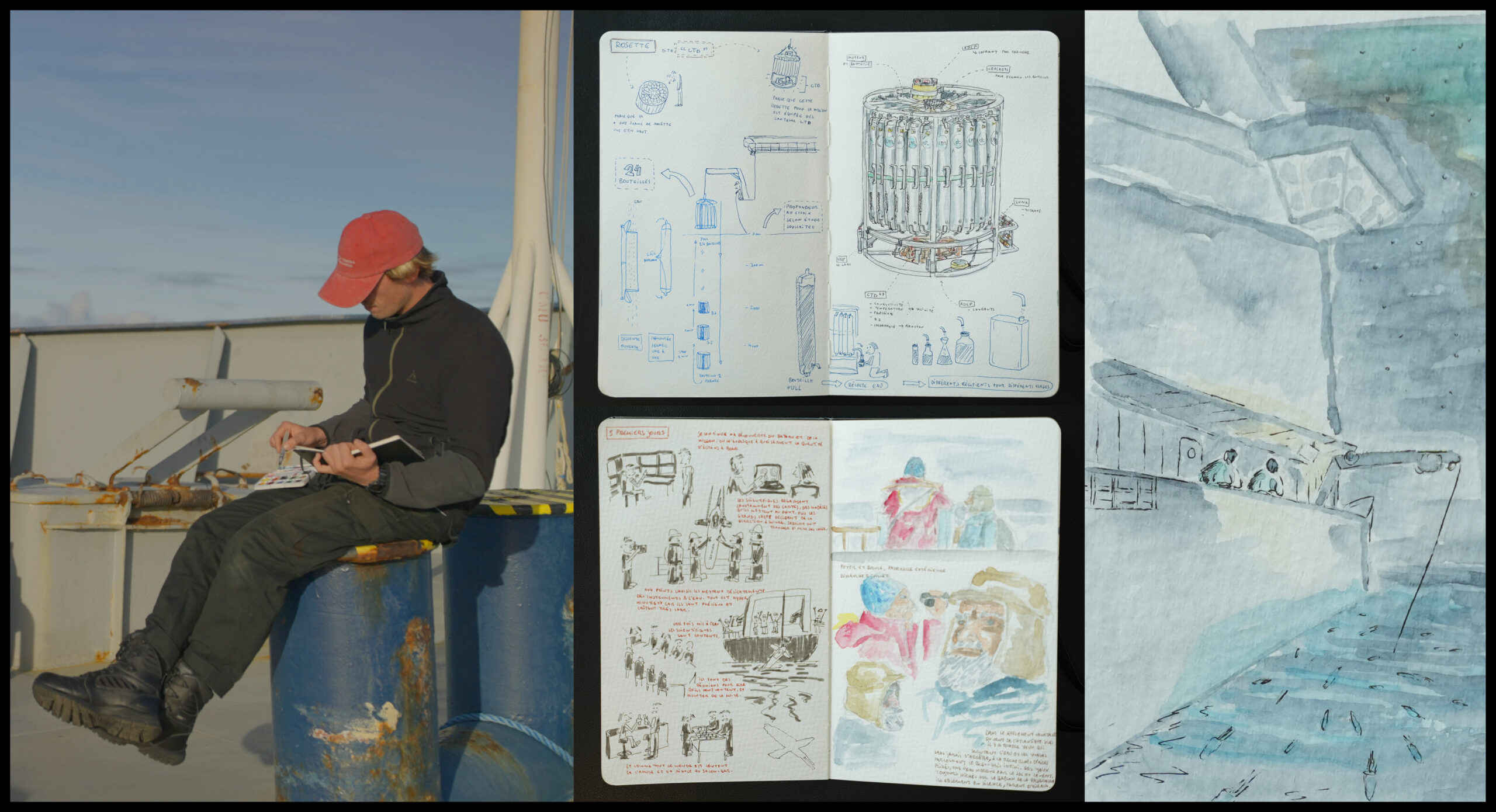
I board the Marion with a notebook, a pencil, a microphone, and a camera. I continue my research and creative work around oceanic lines and the understanding of ocean mechanisms through images. In my notebook, I trace lines with ink to understand, through drawing, what is happening at sea. On land, during the summer season, I work alongside the ocean in a lifeguard station on the Atlantic coast, and this nourishes my artistic work around the metamorphosis of coastal landscapes. I joined the WHIRLS expedition to understand how the ocean organizes itself, and how it organizes life and climate. To shift my gaze from the coast to the vast open ocean.
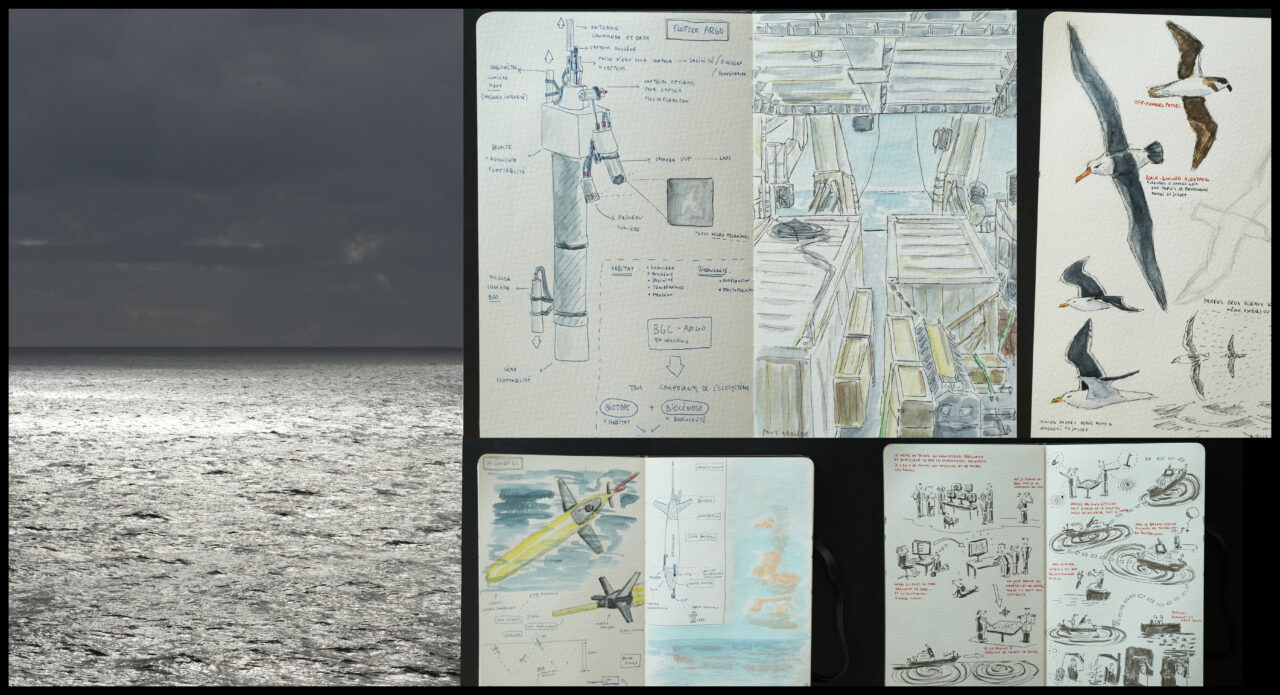
Keeping a drawn journal allows for two important things in this life at sea: the first is to understand, through an external, non-scientific perspective, the diversity of an oceanographic mission, and to find another language through which to convey it. The second is to create a dialogue through drawing between the different people on board.
In a world where the omnipresence of images can saturate our spaces of understanding, drawing still holds the magic of bringing people together on board. While flipping through the journal, we gather around a page, we discover the diversity of the studies carried out on the ship, and we retrace the story of a month at sea. Through the transformation of forms, we shift our perspective; through a simple stroke, we create a connection. Completing these thirty days with sound recordings and images allows me, like the scientists, to return to land with a collection of material. This material will serve me to speak about the ocean and its movements. A work that begins with a line. A trait d’union.
Author: Siann Bergbaum, originally written in French
Translation by: Elisa Carli and Solange Coadou-Chaventon