

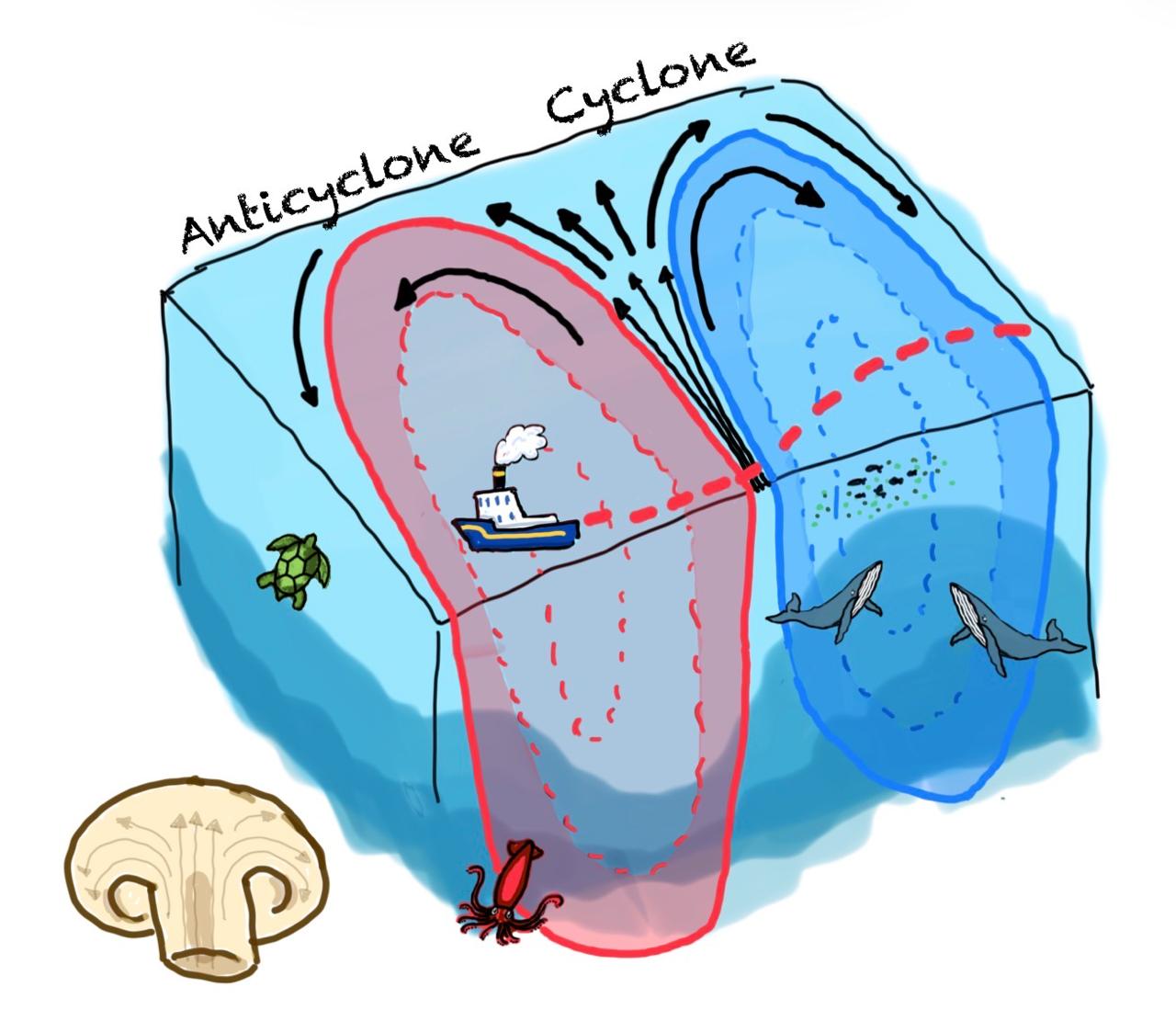
During the WHIRLS campaign, we are targeting a specific dynamic structure: an eddy dipole. This “mushroom-like” structure is composed of two eddies, a cyclone (rotating clockwise) and an anticyclone (rotating counterclockwise), traveling as a pair with an intense jet forming between them. Our study region, the Cape Basin, is a hotspot for the development of such dipole structures.
Transporting Heat, Nutrients, Salt, and Organisms
As the Agulhas Current, a strong current flowing along the continental slope of eastern Africa, retroflects south of Africa, it sheds large anticyclonic eddies known as Agulhas rings. These anticyclones contribute to an important export of warm and saline water, characteristic of the Agulhas Current, into the Atlantic Ocean.
Cyclones, also forming south of Africa, then couple with the anticyclones. The strong jet in between the two eddies transports heat, salt, nutrients, plankton, and tiny marine organisms over hundreds of kilometers horizontally. Additionally, frontal dynamics at the edges of the dipole’s eddies promote vertical motion, facilitating nutrient upwelling. The resulting productivity in these offshore environments aggregates prey in the upper water column, sustaining the food web from lower trophic levels up to seabirds and marine mammals.
Frontal characteristics of eddy dipoles drive exchanges of heat, moisture and momentum (kinetic energy) between the surface ocean and overlying atmosphere, influencing surface wind patterns, cloud formation, and other atmospheric processes.
Understanding this complex system requires collaboration between experts across disciplines – from oceanic and atmospheric physics to genomics and marine mammal ecosystems. Thus, the WHIRLS campaign brings together such experts from multiple institutions. Regular meetings are held onboard to discuss the best ways to sample and characterize the dipole.
Locating the Eddy Dipole and Deploying Observation Instruments
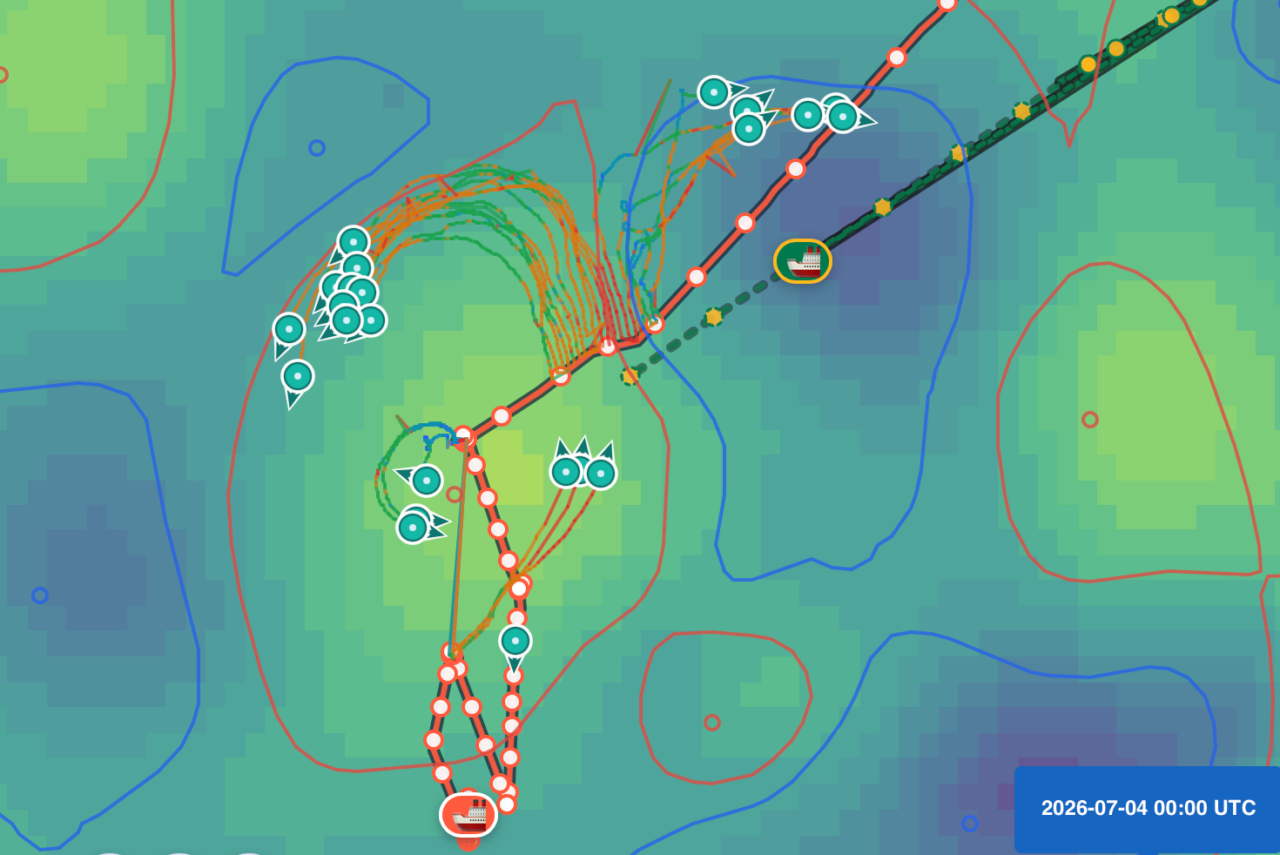
During the first days of the campaign, we successfully located our target eddy dipole by using satellite observations including sea surface height and ocean surface temperature. As our vessel crossed the dipole, in-situ observations of currents, temperature and salinity from instruments such as the Ship Acoustic Doppler Current Profiler (SADCP) and the Thermosalinograph (TSG) allowed us to precisely assess the location and structure of the dipole’s boundaries.
With the eddy dipole identified, we deployed a fleet of instruments – including autonomous platforms like seagliders and wavegliders, Argo biogeochemistry floats, and drifting platforms – to study the region. Our first results from 20 drifting platforms deployed in the dipole jet clearly confirm the mushroom-shape of the eddy dipole.
As we continue sampling across this feature, we will conduct numerous CTD (conductivity, temperature, depth) casts for biogeochemistry analyses, use drone surveys and radiosondes to measure the atmosphere, conduct abundance surveys of marine mammals and seabirds, pilot underwater gliders and surface vehicles, and more to understand this complex system.
Stay tuned as we investigate this exciting feature!
Featured image: Artistic schematic of the “mushroom-like” eddy dipole circulation, the vessel’s trajectory across it and an example of biological abundance. By: Neha Ramsarup and Clara McKellar
Main contributing authors:
- Clara McKellar
- Neha Ramsarup
- Solange Coadou-Chaventon
- Elisa Carli
- René Schubert
- Mduduzi Seakamela