

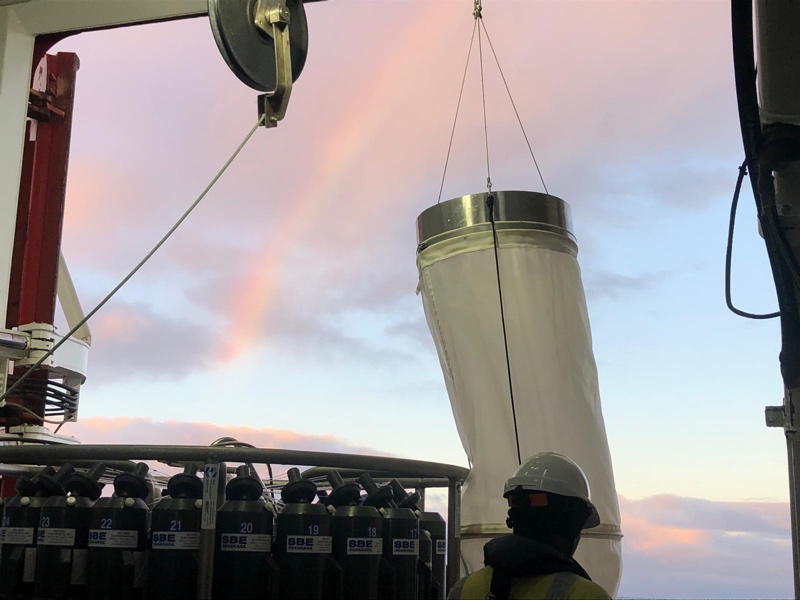
Plankton nets are the most efficient tools for collecting organisms at sea. The smallest one used aboard the Agulhas II ship is a long, conical funnel with a mesh size of 20 microns and a 60 cm diameter opening. The crew helps us deploy it vertically down to 150 meters, below the euphotic layer, before pulling it back up at a speed of 0.5 m/s. As it ascends, the net filters seawater, capturing all kinds of planktonic life in its path.
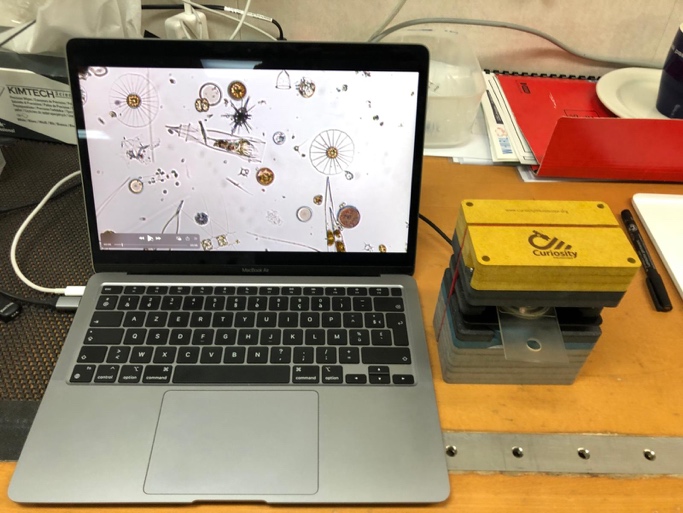
Once on deck, the collector at the bottom of the net is filled with particles and organisms larger than 20 µm that inhabit the 0–150 m water layer. The samples are then divided for various analyses, including light and scanning electron microscopy, which will be conducted later at the MIO laboratory in Marseille, France. Yet, observations are still possible onboard thanks to two low-tech but highly effective devices: the Planktoscope and the Curiosity. With these simple tools—and a great deal of patience and enthusiasm for examining plankton cells—we have already imaged and identified 212 different species during the cruise, as well as obtained >85,000 plankton vignettes. Many more discoveries await us with the advanced research microscopes back at the lab.
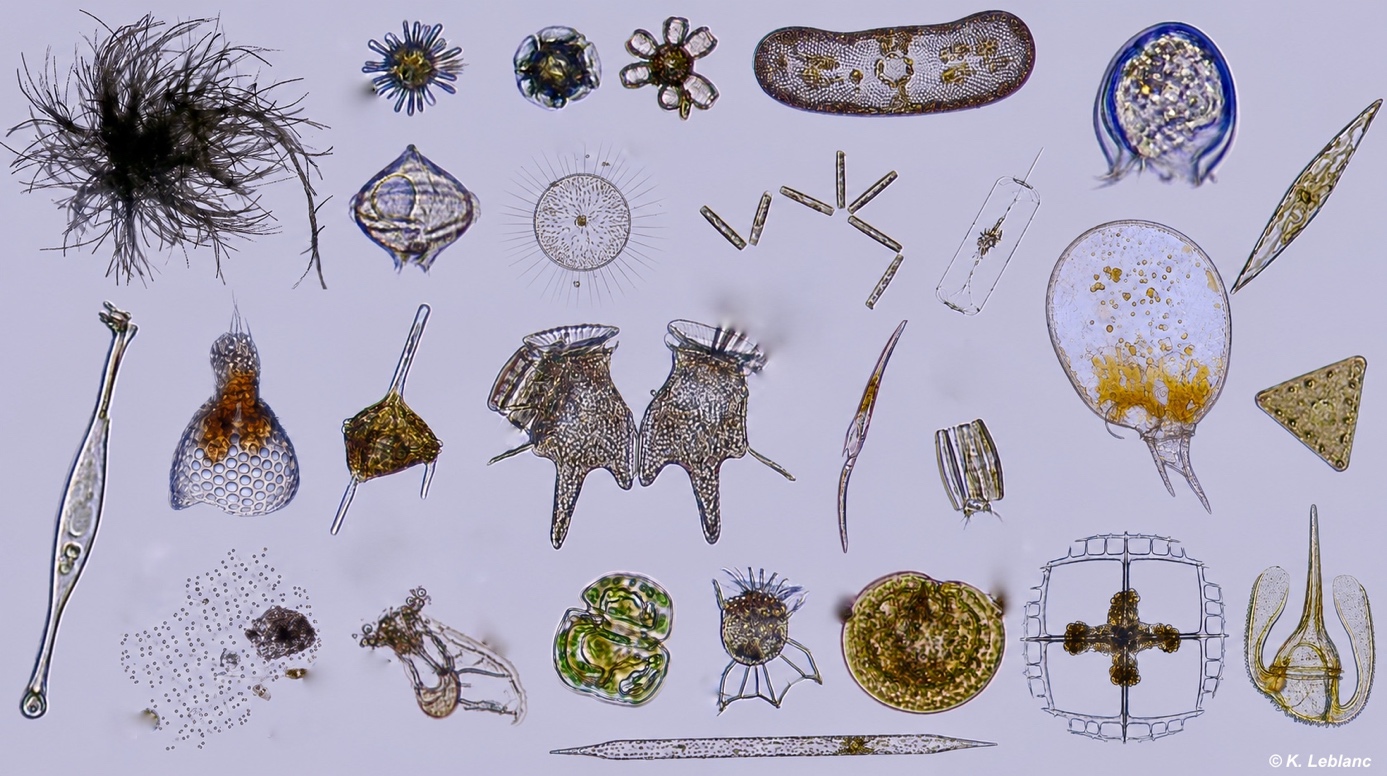
Among our findings, silicifying plankton stood out, including photosynthetic organisms like diatoms (57 species identified) and heterotrophic or symbiotic Rhizaria (over 50 different morphotypes observed). Dinoflagellates, which can be autotrophic, heterotrophic, or both (mixotrophic), were the most diverse group, with over 67 species recognized—including more than 25 species from the genus Tripos alone! While coccolithophores (plankton that build calcareous plates) were less abundant, we still observed about 12 distinct species. We also spotted close to 25 different kinds of tintinnids, tiny protists that swim vigorously through the water. The famous nitrogen-fixing Trichodesmium was frequently seen in the nets, often in the form of puffy colonial formations.
In the microsize fraction, the most abundant organism was the stunning diatom Fragilariopsis doliolus, which forms barrel-shaped colonies. These are often found in association with tintinnids, which we observed darting around with diatoms hitching a ride on their backs. Excitingly, two new associations—between other diatoms and tintinnids—never described before, were observed and even filmed!
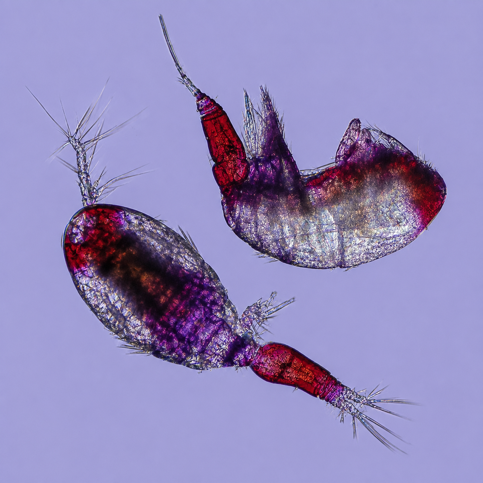
The zooplankton nets also revealed colorful tiny crustaceans, adding to the beauty of our discoveries. Identifying and counting all these specimens will take us another year or more. But once this work is complete, we’ll gain a remarkable understanding of how the different conditions in the cyclonic and anticyclonic eddies we’ve encountered can explain the fine-scale distribution of these diverse planktonic groups. To be continued…
Featured image: A collage of the different planktonic organisms imaged with the Curiosity on board. Photo credit: Karine Leblanc
Author: Karine Leblanc (CNRS, France)