

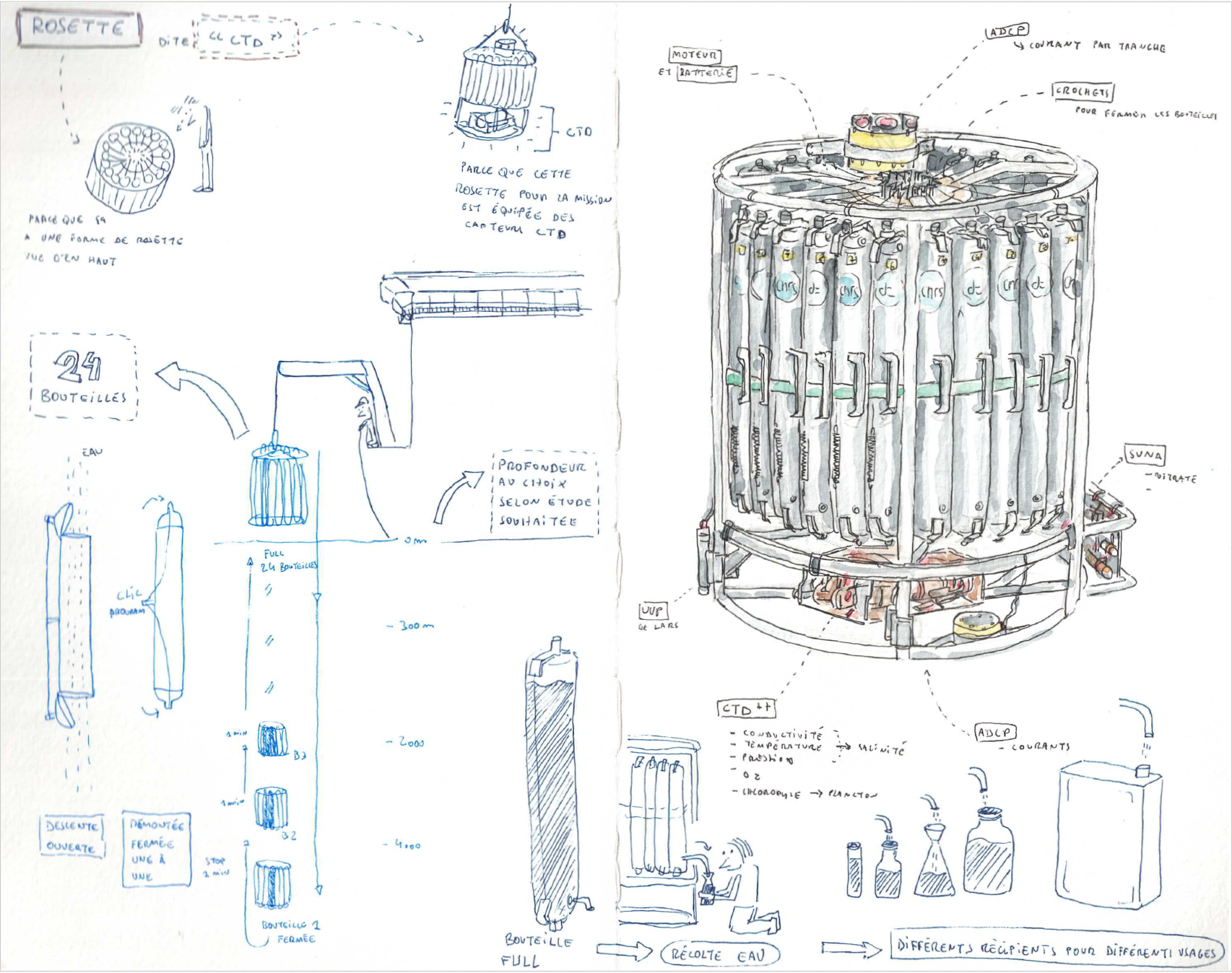
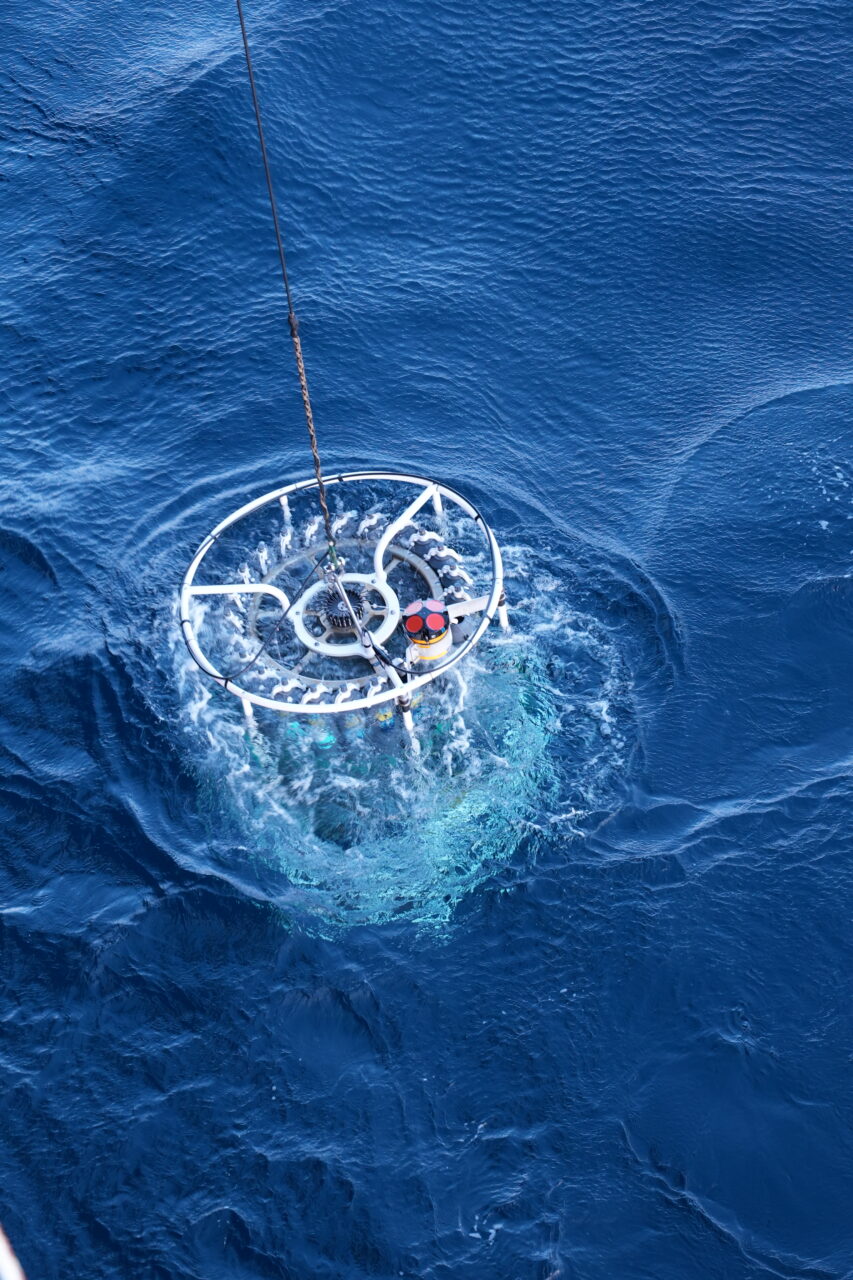
One of the most important pieces of equipment used during an oceanographic research cruise is the CTD. CTD stands for Conductivity, Temperature, and Depth, although the instrument also carries additional sensors that measure other properties of seawater, such as oxygen, fluorescence, turbidity, and nitrates. As the CTD is lowered through the water column, it records these measurements continuously, providing scientists with a detailed profile of the ocean from its surface to thousands of meters deep. During our cruise, most CTDs are lowered to 1200m; however, two deep CTDs have reached the Antarctic Bottom Water at 4871 m.
The CTD is attached to a rosette, a circular frame which is fitted with a series of large sampling bottles, called Niskin bottles (in our case they contain 12L of water each). These bottles remain open while the CTD is lowered and are closed electronically at pre-selected depths by CTD operators during its return to the surface. Thus, seawater can be collected from specific depths for various analyses.
At some stations, two CTD casts are carried out. Conducting separate casts ensure that the different scientific teams can collect the samples they require while maintaining the quality and integrity of the water samples.
The first is a shallower cast to 300 m – dedicated primarily to biological sampling. From it, we collect plankton of different sizes for metagenomics, metatranscriptomics, metaproteomics and metabolomics — i.e. the whole DNA, mRNA, proteins and metabolites present in the water at selected depths (surface and deep). We also collect water for nucleic acid and protein metabolites extraction as well as sequencing and analyses of viruses, bacteria, phytoplankton and small zooplankton. These analyses will be used to better understand the community structure, including the species that are present, how they are distributed along environmental gradients, and how their metabolism interacts with the surrounding physico-chemical context.
The second cast extends to the full sampling depth of approximately 1 200 metres. Once the CTD is safely back on deck, water is taken from the Niskin bottles in a carefully planned order. This sequence is important because some analyses are particularly sensitive to environmental contamination or changes in the water after sampling. The typical order is:
- Gases (oxygen and alkalinity, DIC (dissolved inorganic carbon))
- Chemistry (ammonium, nutrients, organic matter, total dissolved nitrogen isotopes)
- Biology (chl-a, other phytoplankton pigments)
Salinity and oxygen samples are collected and are used to calibrate the CTD’s conductivity sensor, ensuring that the instrument’s measurements remain accurate in time.
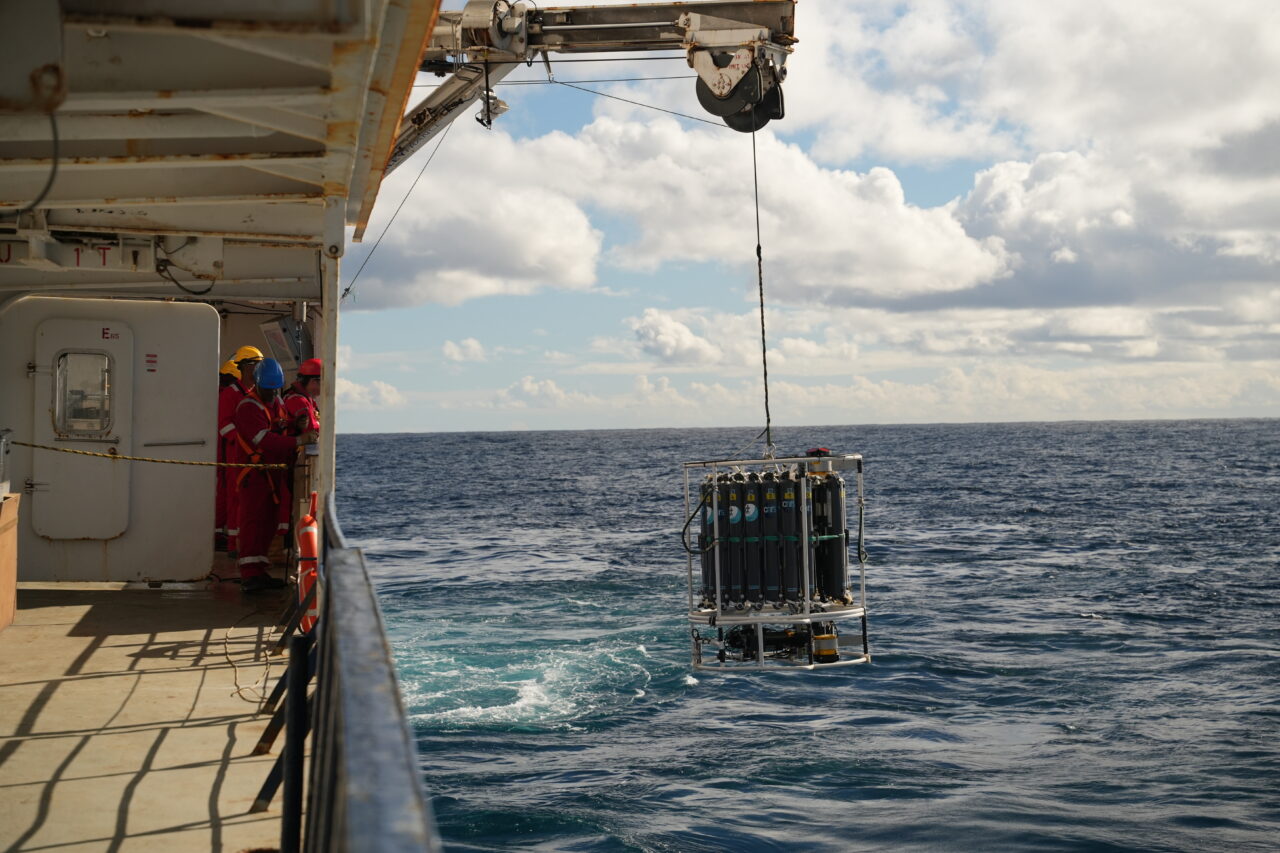
The positioning of the stations is carefully chosen by scientists to sample a variety of dynamical systems. On the R/V Marion Dufresne, we had 37 stations and 70 CTD casts concentrated mainly in two high resolution transects (one sample every 2 km), with extra stations in key locations such as the center of the eddies. The first high-resolution transect targeted the edge of the anticyclone to collect water outside and inside of it. The second high resolution transect targeted the jet of the dipole.
Although operating a CTD may appear straightforward, it is a coordinated effort involving the ship’s crew and scientists from multiple disciplines. Careful planning, precise sampling, and close teamwork ensure that each water sample accurately represents the conditions at the depth from which it was collected.
Featured image: Artistic representation of a CTD rosette and the process of collecting seawater samples. Artist: Siann Bergbaum
Authors: Christiaan van Niekerk and Lucia Campese