

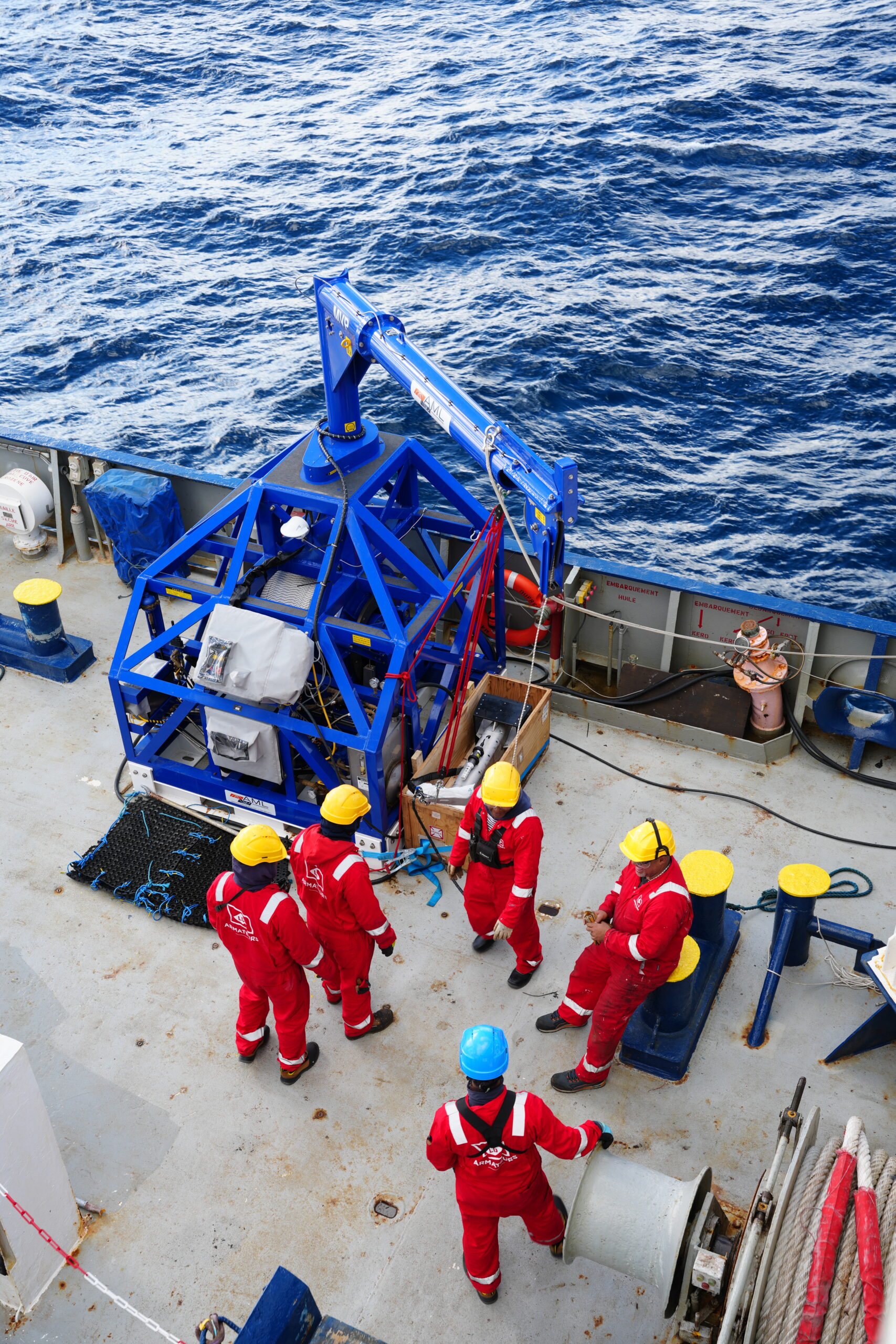
For as long as ships have studied the sea, measuring the ocean’s interior has meant stopping. You halt the vessel, lower an instrument on a cable, wait while it sinks and rises, haul it back, and only then steam on to the next spot, often tens of kilometres away. It works, but it leaves the ocean sampled like a string of lonely lampposts on a very long, dark road. Between them, anything can be happening, and usually is.
On board the RV Marion Dufresne, WHIRLS is doing something different, and something that, as far as we know, has never been done before.
We have acquired a Moving Vessel Profiler 300 (MVP) and, for the first time ever, we have equipped its “fish”, the towed body that carries the sensors and electronics and rides the cable back to the computers on the ship, with a full suite of instruments measuring the ocean’s physics, chemistry and biology all at once.
The idea behind the MVP is simple. Instead of stopping, it profiles while the ship keeps moving. The fish is towed behind the vessel and, as we sail, it dives and climbs, dives and climbs, plunging and resurfacing at more than 3 metres per second, a remarkable speed for an instrument acquiring data the whole way, and tracing a continuous sawtooth through the top kilometre of the ocean over and over again.
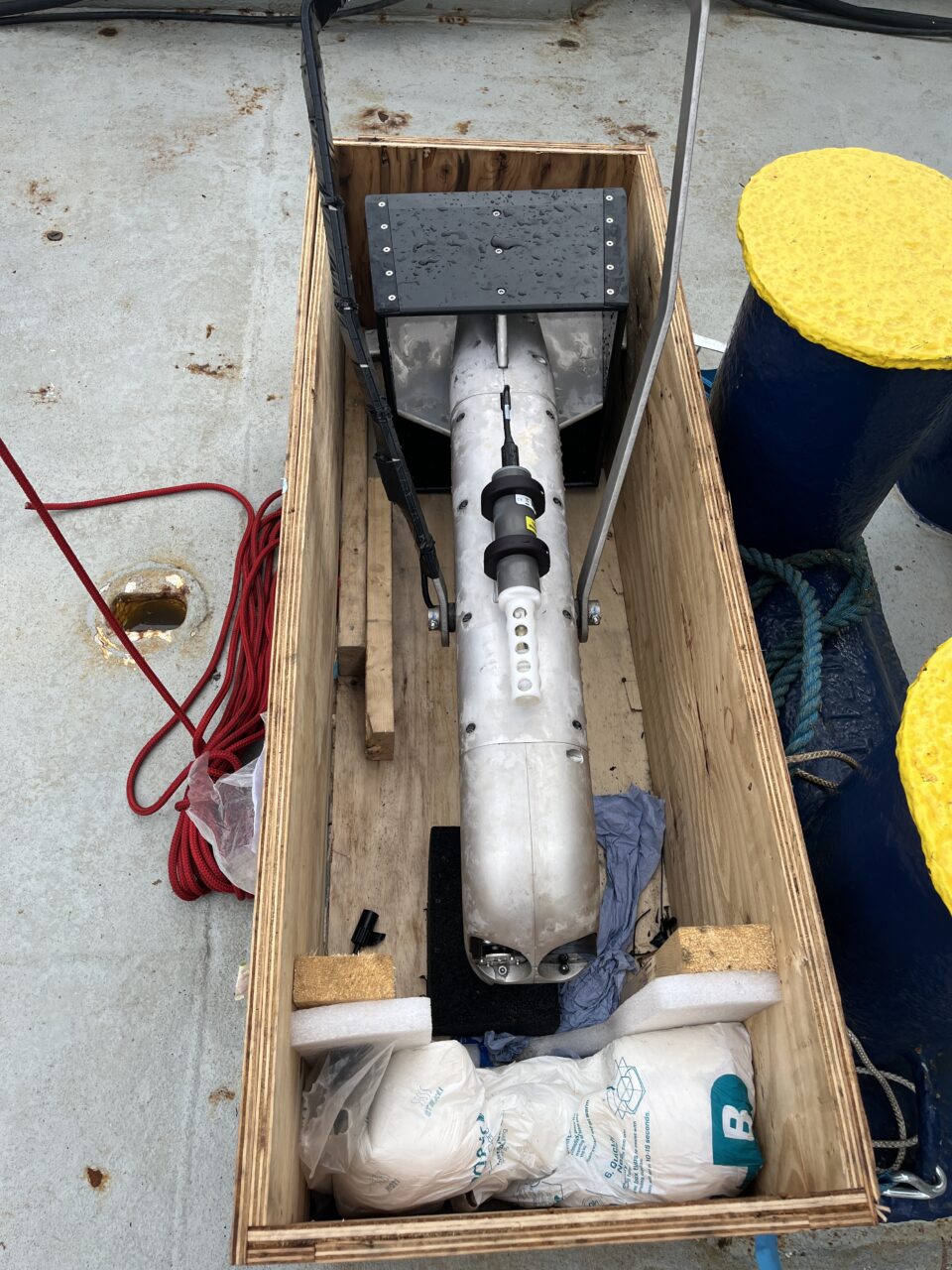
That pace is part of the trick. Diving that fast, the fish completes each thousand-metre round trip in just a few minutes, which is how we get a full profile roughly every kilometre along our track without the ship ever slowing down. Sending a whole suite of delicate sensors racing up and down through the water that quickly, and still coming back with clean, finely resolved measurements, is no small achievement.
The sensors riding that fish make this special. Getting this many sensors to live together on a single fish, powered, synchronised, and diving through the water again and again, is a genuine world first, and it has changed how much of the ocean we get to see. On each dive it reads the ocean’s physics, temperature, salinity and pressure, alongside its chemistry and biology: oxygen, chlorophyll, water clarity through a transmissometer, nutrients, and pH. Never before have all of these been mounted together on a moving profiler. So every kilometre we don’t just learn how warm or salty the water is, but how alive it is, how much oxygen it holds, how the light and particles change with depth. Physics and biogeochemistry, side by side, all the way down.
What that resolution reveals has been a revelation. At one profile per kilometre, we can watch the mixed layer, the ocean’s breathing surface, thicken and thin along the track. We can see the sharp edges of eddies, those giant rotating rings WHIRLS came to study, and peer into what actually happens at their boundaries, where one body of water grinds against another. We can catch the narrow, fleeting features between eddies, and between an eddy and a passing current, the submesoscale filaments and fronts that are too small and too short-lived for satellites to resolve, yet where a surprising amount of the ocean’s mixing, sinking and stirring takes place.
This is exactly the piece WHIRLS was missing. Our satellites give us a view of the wide surface. Our eddy analyses tell us where to point the ship. Our floats and gliders reach into the depths at chosen spots. And now the MVP, with its uniquely equipped fish, fills in everything in between, drawing a near-continuous curtain through the upper ocean so that the eddies and fronts we track from space finally reveal their inner structure. Surface to depth, kilometre by kilometre, while we simply keep sailing.
The ocean at these scales is richer, sharper and more full of life than a stop-and-go view could ever suggest. With the MVP 300 humming behind the Marion Dufresne, a fish carrying more than any has carried before and diving faster than seems possible, we’re finally getting to watch it unfold.
Featured Image: Crew members get ready to deploy the MVP’s fish. Photo credit: Siann Bergbaum
Author: Sabrina Speich