

Within the eddy dipole, we are focusing on regions with specific characteristics, such as the anticyclone core, the eddies’ edges and the central jet. To study these regions we create “superstations,” where we deploy multiple instruments at the same location.
Ahead of the cruise we identified two superstations with different aims: one in the anticyclone center addressing oceanic and atmospheric physics as well as their interaction; and one at the southern anticyclone boundary focusing on physical, biological and chemical interaction. In the next posts we will go into detail about superstation locations, their unique scientific values and the instruments deployed.
Adaptive Sampling Strategy
To plan the location of a superstation, scientists need to account for multiple parameters:
- Weather
- Scientific needs
- Live and future ocean conditions
Each of these parameters can change quickly which is why the WHIRLS cruise follows an adaptive sampling strategy instead of a pre-defined one.
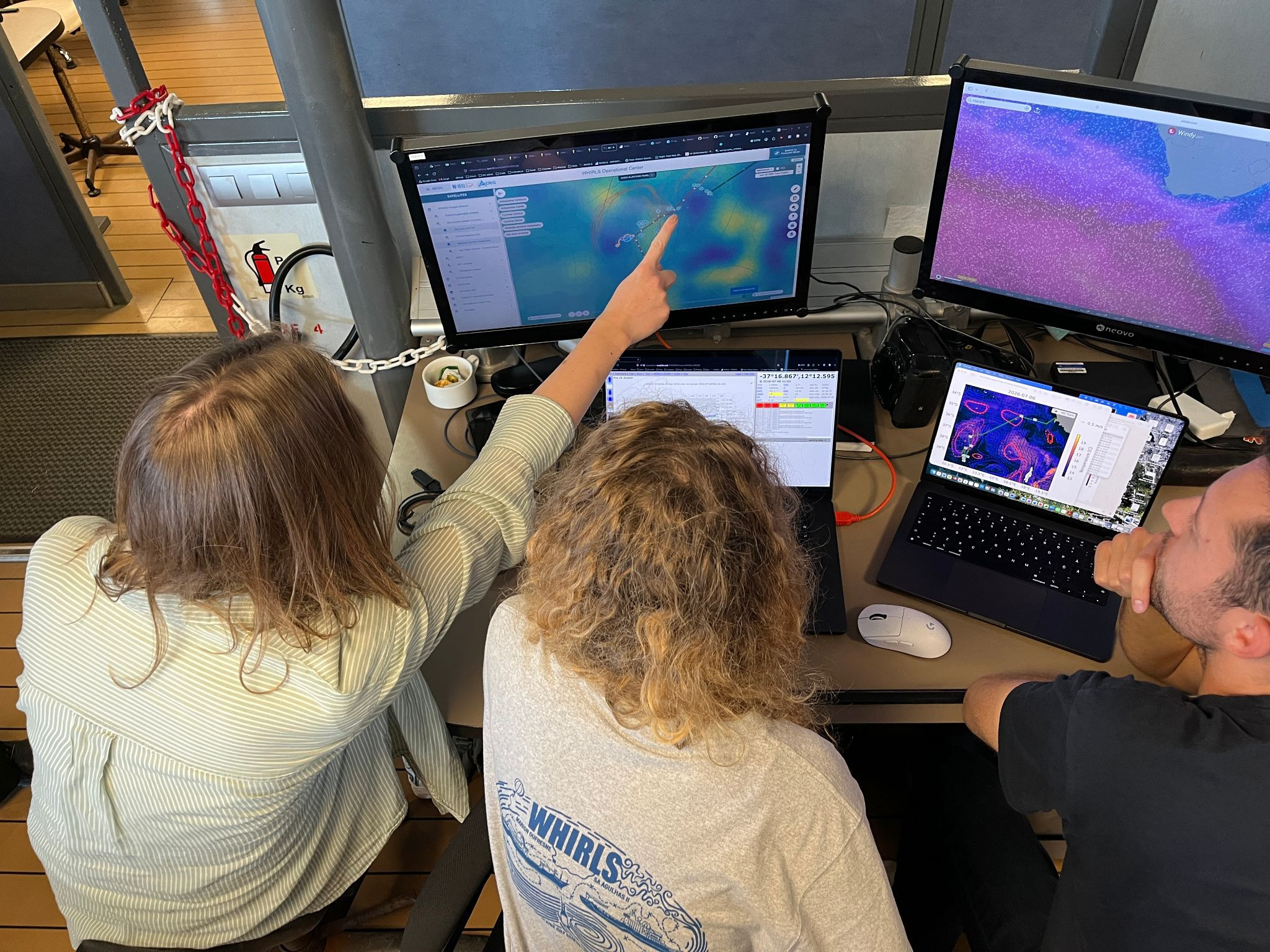
Planning the First Robotics Superstation
The first superstation is located within the anticyclone center. To plan this superstation, we:
- Analyzed the weather forecast. This revealed a very short, favorable weather window for instrument deployment (winds less than 5m/s and wave height below 2 m) before the conditions degraded;
- Forecasted the ocean condition. We added satellite sea surface height and sea surface temperature data as inputs into the VarDyn algorithm to build a forecast of the ocean’s dynamical state.
- Identified the future eddies’ shapes and locations using eddy detection algorithms, including TOEddies, on the forecast field.
Following these analyses, we provided precise coordinates of the eddy center to the bridge and set a transit time of 18 hours before the start of the instruments’ deployments. Simultaneously, we prepared our instruments for deployment, including where, when, and by whom instruments would be deployed.
Check out our next post about our super deployment day when we deployed five different types of robotic instruments – including one that is 19 m long!
Authors: Elisa Carli, Solange Coadou-Chaventon